DIY Free Toolchain for Kinetis: Part 8 – Processor Expert, Eclipse and GNU ARM Eclipse Plugins

There has been many new releases these days: Freescale released Processor Expert Driver Suite 10.3, and Liviu Ionescu released new GNU ARM Eclipse Plugins with new and updated documentation. So time for me to show how this all comes together 🙂

Processor Expert Driver Suite 10.3 Project with GNU ARM Eclipse Build Tools

Processor Expert Driver Suite 10.3 Project with GNU ARM Eclipse Build Tools

It is now easier than ever before to use the GNU ARM Eclipse plugins and Processor Expert. There are still some manual steps, and this post is about all the details to get it working as smooth as possible.
Continue reading

Tower Prototyping: PROTO Board, Breadboard on Ebay

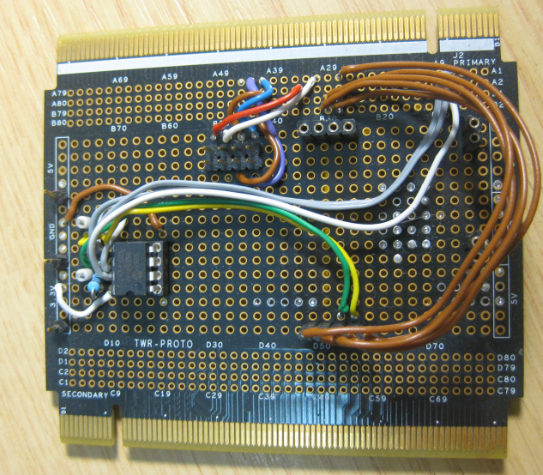
The Freescale Tower boards are very versatile, and there are many different boards you can combine like lego bricks. When I tinker with my own hardware or need to try out something, then I use a special prototype board: the TWR-PROTO.

Tower Proto Board Frontside

Tower Proto Board Frontside

Continue reading

DIY: Changing Processor Expert Components

I’m maintaining and hosting now more than 100 different Processor Expert components on GitHub. Instead to deal with CDE (Component Development Environment, that’s the SDK to create your own components), most users simply download and install the PEupd files. If you deal with normal source files, and if spot something you want (or need to change), then you can easily do this. But what if you want or need to change something in that code which comes with the PEupd file(s)?

Components in the Components Library

Components in the Components Library

Continue reading

Debugging the same Project Multiple Times in Parallel with Eclipse

I have I project which I want to debug on multiple boards the same time. So how can I download and debug the same application to multiple boards/processors, and debug them all the same time from within the same workspace and Eclipse IDE?

This is a typical scenario I have with my RNet stack: the same application runs on multiple boards, and I want to debug all the boards with the same project with the same Eclipse. For example to wireless sensor nodes with the RNet nRF24L01+ stack as in the picture below:

Two FRDM-KL25Z with nRF24L01+ Transceivers

Two FRDM-KL25Z with nRF24L01+ Transceivers

Continue reading

DIY Free Toolchain for Kinetis: Part 7 – GNU ARM Eclipse Plugins

Tired by the tool chains provided by your silicon vendor? Do you want to use a free and open tool chain? Then you probably followed by “DIY Free Toolchain” series already. In “DIY Free Toolchain for Kinetis: Part 2 – Eclipse IDE” I used the standard GNU Eclipse plugins. As mentioned in above post, there is an even better and more powerful plugin available: the GNU ARM Eclipse plug-ins. There is a dedicated blog site which provides excellent documentation and direct access to new and frequent releases. And these days there is a true a Christmas gift for every Eclipse lover: the version 1.1.7 with the addition of J-Link debugger plugin :-).

GNU ARM Eclipse (http://gnuarmeclipse.livius.net)

GNU ARM Eclipse

Continue reading

Eclipse Build Variables

This post is not about variables in my application code (which I debug). It is about using Variables in Eclipse for building projects. Eclipse variables allow me to make my projects ‘position independent’ whenever I cannot use a path relative to my projects or workspace.

Eclipse Variables

Which variables are used where in Eclipse might be sometimes not very clear. Depending in which context variables are used, not everything might be available. This link for example gives a list of variables which can be used to invoke an external tool.

Build Variables

Eclipse comes with many built-in variables, especially for the build system. If I want to see what variables are already defined, I can show them in the project properties, under C/C++ Build > Build Variables with enabled option ‘Show system variables’:

System Build Variables

System Build Variables

Continue reading

Zumo Robot Last Tuning Tips

Tomorrow will the STD (Sumo Tournament Day)! Here are a few last tips and tricks to be prepared for that Sumo Tournament using the Pololu Zumo Robot chassis:

Battery Inertia

If two robots crash into each other, there can be quite some force. What I have observed is that it can be strong enough to temporarily disconnects the batteries from their spring contacts. I use pieces of plastic parts to keep the batteries tight and in place.

Battery Enforcement

Battery Enforcement

Continue reading

Processor Expert CDE: Debug Verbose Mode

I have one rule I try to follow every day: my code shall be warning free. Writing software for multiple compilers gets challenging with this rule, but it avoids the ‘not seeing the forest because of the trees’ problem. This rule extends to writing Processor Expert components with CDE (Component Development Environment). What I have missed (and not used) is a useful option to enable debug output:

Enable Processor Expert Components Debug Verbose Mode

Enable Processor Expert Components Debug Verbose Mode

Continue reading

Kinetis Unique Identification Register

For my RNet stack I need a way to identify nodes in the network using a unique address. What I need is Media-Access (MAC) address. Base on such a unique address I can assign short addresses (e.g. with a DHCP or similar protocol to automatically assign shorter network addresses). So how to uniquely identify my network nodes?

The Freescale Kinetis microcontroller have nice feature: they have a Unique Identification Register (UID) which would be a perfect fit for a MAC address :-).

UID Output

UID Output

Continue reading