A Processor Expert Component to Help with Hard Faults

Ahrg! Again my ARM application crashed somewhere and I ended up in a HardFault exception :-(. In my earlier post I used a handler to get information from the processor what happened. But it is painful to add this handler again and again. So I decided to make things easier for me: with a special HardFault Processor Expert component :-).

After adding this HardFault component to my project, it automatically adds an entry to the vector table. So no manual steps are needed: having the component in the project and enabled will do the needed steps.

Continue reading

Migrating Kinetis-L Projects from Beta to Final MCU 10.3

I have successfully used CodeWarrior for MCU10.3 beta version for many projects. With the advent of the final CodeWarrior for MCU10.3, I want to migrate my existing projects to the new and final version. First: my existing projects work as well in the final version, which is good news. But there are two things to change to take advantage of the final 10.3:

  1. Linker file memory split
  2. ARM Micro Trace Buffer (MTB) support

Continue reading

LED’s for Kinetis, simplified

Sometimes it takes a while until things get better. Same thing applies to software: from time to time a refactoring and simplification makes sense. Especially if the underlying technology has been improved. With CodeWarrior for MCU10.3 available, it is time to refactor the LED component.

Continue reading

HD44780 2×16 Character Display for Kinetis and Freedom Board

In my earlier Nokia LCD post I described a ‘free of charge’ way to add a LCD display to my FRDM-KL25Z board. If that Nokia display is not available, or an alphanumeric display is enough, then the Hitachi HD44780 display is a low cost option as well.

The HD44780 (or compatible) display is one of the most common displays available. And they usually conly costs around $10 or less. I have used a ‘blue’ 3.3V version of such a display already in my lectures with a Freescale S08 microcontroller. So I thought it would be nice to port the driver to the Kinetis and the KL25Z on it.

LCD Boards with FRDM-KL25Z

LCD Boards with FRDM-KL25Z

A recent post of TKJ Electronics about such a really inexpensive (only $5) HD44780 display caught my attention. And finally I had two of such TKJ displays in my postal mail box yesterday. Time to have some fun on a weekend 🙂

Continue reading

Reducing Code Size with gcc and EWL

If you have not noticed: the final CodeWarrior for MCU10.3 has been released on the Freescale web :-).

It comes with a few changes compared to the 10.3beta release, and one is about the library configuration. I noticed that new projects created with the wizard are around 4 KByte larger than I expect them to be. For example my rather simple application below uses 8 KByte of code, where my expectation would be in the range of around 4 KByte:

   text       data        bss        dec        hex    filename
   8644         24       1108       9776       2630    Freedom_2x16_HTA.elf

Continue reading

FRDM-KL25Z with the Arduino Motor Shield

The great thing with the Freedom FRDM-KL25Z board is its compatibility with Arduino Shields: a great set of board available at very reasonable prices. I had my hands on the Adafruit Data Logger shield, and now it was time to use the original Arduino Motor Shield R3.

Freedom FRDM-KL25Z with Arduino Motor Shield and Arexx Chassis

Freedom FRDM-KL25Z with Arduino Motor Shield and Arexx Chassis

Continue reading

KL25Z and I2C: Missing Repeated Start Condition

I really hate this kind of stuff: I know it should work, but it does not. I’m loosing a lot of time (hours, days, even weeks) to track it down to the root cause. Yes, I create my own bugs. Yes, there are bugs in tools, sources, libraries and components. But what many might not believe: there are bugs in silicon too :-(. If you do not believe, here is one: there is a hardware I2C problem on the KL25Z used on the Freedom board. It worked in one project, but not in another.

❗ The silicon bug described here is present on many Kinetis devices, not only the KL25Z!

Logic Analyzer attached to the FRDM-KL25Z board

Logic Analyzer attached to the FRDM-KL25Z board

So if you are facing a problem where you read 0xFF or wrong values from the I2C bus with the KL25Z, here is probably why (and how to workaround it). The problem showed up with a modified version of the Freedom Accelerometer tutorial….

Continue reading

A Generic I2C High Level Driver

I’m working with the I2C bus recently a lot. I’m using it in a project to reverse-engineering skimming (credit card fraud) devices. I needed to improve one of my applications for the lecture classes where a MCF52259 is communicating with a TWR-LCD display over I2C. And I want to add RTC (Real-Time-Clock) capabilities to my Arduino Data Logger Shield which requires I2C.

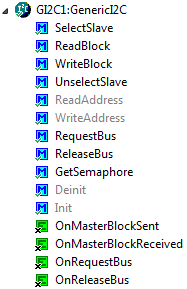
The same time I want to have things working with ARM Cortex-M4 and M0+ devices. And here the challenge started: using the I2C_LDD (Logical Device Driver) Processor Expert components for the ARM Kinetis devices is definitely not simple and easy. I want to use my software compatible for both the ARM cores and say for S08 and ColdFire cores. So what I ended up is to write a ‘generic’ I2C driver on top of the low level Processor Expert components: named GenericI2C.

Generic I2C Component

Generic I2C Component

Continue reading

Debugging Hard Faults on ARM Cortex-M

It is as bad as this: my application stopped in an unhandled interrupt service routine:

Cpu_Interrupt
Cpu_Interrupt

That does not tell much. I’m using Processor Expert generated code, and with this all my ‘unhandled’ vectors are pointing the same handler:

Continue reading

Arduino Data-Logger Shield with the FRDM-KL25Z Board

One success factor of the Arduino platform is the broad availability so-called ‘shields’: hardware plugin-modules which extend the capability of platform. Shieldlist.org currently lists 288 different shields available! Clearly, Freescale wants to benefit from that ecosystem with the Freedom FRDM-KL25Z board which features Arduino compatible headers. Time to use the Freedom board with an Arduino shield :-).

Data Logger Shield on Top of Freedom Board

Data Logger Shield on Top of Freedom Board

Continue reading