Debugging Failure: Check List and Hints

I think the biggest frustration point for any new or even seasoned engineer is the debugging phase: my application finally builds fine, but I’m not able to connect and download it to the target board :-(. In my view the debugging part is the most fragile part of the development process. I’m always very relieved if I can connect to a brand new board, because I know if it does not work, then the problem could be a very bad one, costing my several hours or even days to overcome it.

Remote Communication Error

Remote Communication Error, what now?
Continue reading

Step-by-Step: Updating OSBDM/OSJTAG Debug Firmware

While new Freescale boards come with the OpenSDA debug firmware, I still students using boards with the OSBDM/OSJTAG. And with new CodeWarrior tools, it might be that there is a new OSBDM/OSJTAG firmware, and when I download to a board with an older firmware, the tool will prompt me to update the firmware. To me, after doing this several times, not a big deal. But for someone who sees this the first time, it might not be that easy. So to avoid any further questions, here we go with a step-by-step tutorial how to update the OSBDM/OSJTAG firmware.

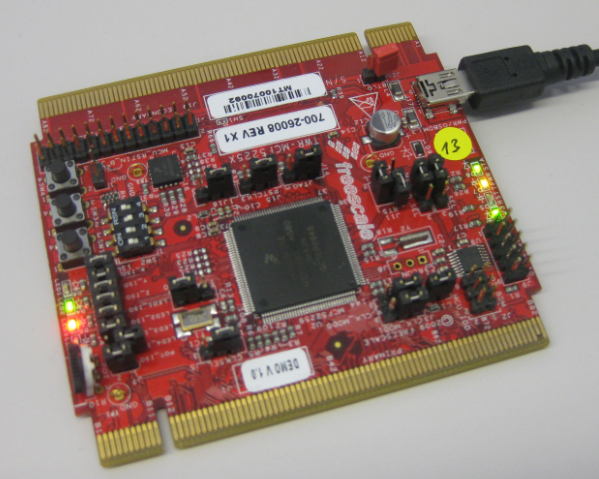
MCF52259 Tower Board with OSBDM Firmware

MCF52259 Tower Board with OSBDM Firmware

Continue reading

FreeRTOS V8.0.0 Final Release available as Processor Expert Component

The final FreeRTOS V8.0.0 has been released last week: time to update the Processor Expert component for it, and this time it is really a major release 🙂 : from V7.5.0 to V8.0.0:

FreeRTOS V8.0.0 Processor Expert Component

FreeRTOS V8.0.0 Processor Expert Component

FreeRTOS V8.0.0 comes with many small changes, especially it now includes many of the extra casts I have contributed to avoid compiler warnings. And additionally it has a brand new feature: Event Groups.

Continue reading

RNet Stack for 8bit MC9S08QE128 Microcontroller and MC13201 Transceiver

I admit: I have used ARM Cortex cores a lot in the recent months. Yes, I think with the ‘ARM domination of the world’ over time the ARM core will blast away probably all other cores, except for niche players? Still, there are reasons to use non-ARM cores, and even if it is just that I have a board at hand :-).

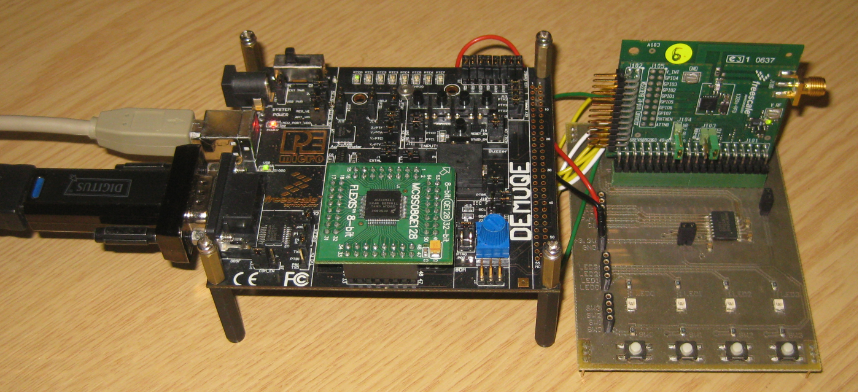
DEMOQE with MC9S08QE128 and MC13201 Transceiver Card

DEMOQE with MC9S08QE128 and MC13201 Transceiver Card

Continue reading

New CodeWarrior for MCU10.5

On Friday, Freescale has updated CodeWarrior for MCU10 from V10.4 to V10.5, available on http://www.freescale.com/cwmcu10. I have not had much time to use it over the week-end, but here is a list of the things which in my view will make me switch my projects over to 10.5 and use it in my university classes:

  • Smaller: smaller setup and less disk space
  • Faster: faster debugging and flashing
  • Features: Eclipse Juno, detachable editor views, ‘unlimited’ breakpoints, simplified debugger attach/connect/download, and more.

Continue reading

FreeRTOS V7.5.0 released

A week ago, the updated FreeRTOS V7.5.0 has been released on FreeRTOS.org. So time to have my Processor Expert FreeRTOS component updated as well :-).

FreeRTOS V7.5.0

FreeRTOS V7.5.0

Continue reading

Low Power with FreeRTOS: Tickless Idle Mode

It took me a while to find the time to upgrade to FreeRTOS V7.4.2, but finally it is done :-). What caused me to move from V7.2 to V7.4 is a low power application on the FRDM-KL25Z board. V7.4 comes with two major new features: Queue Sets and Tickles Idle Mode (see this article). The last one if of interest here.

FreeRTOS runs an IDLE task. This one runs when there is no other active task. That task calls an optional Idle task hook which is a perfect place to put the microcontroller into low power mode:

Task T1 Running

Task T1 Running

Continue reading

Freedom Track Robot with IEEE802.15.4/SMAC

My other robots based on the FRDM-KL25Z use Bluetooth as connectivity. This one is using a Freescale IEEE802.15.4/ZigBee/SMAC module:

Robot with SRB MC13213 Board

Robot with SRB MC13213 Board as Remote Controller

Continue reading

Adding/Removing Floating Point Format for S08 Projects

Usually I do *not* use floating point numbers in my projects. For this, I select ‘None’ during the project creation in CodeWarrior for MCU:

No Floating Point Selected

No Floating Point Selected

But what if I need to change my mind later? How to change such a ‘no-floating-point-needed’ project to one with floating point format support?

Continue reading

Bluetooth with the Freedom Board

I’m working now on a lecture robot project using my Freedom Board. And for this I need a wireless communication. I already have IEEE802.15.4 (SMAC) working, but I wanted to add Bluetooth as a low-cost option. I have found an inexpensive Bluetooth module which is available for only around $4-8 which we use in another university class project. The module is an AT command module: that means the microcontroller communicates with AT serial commands with the module, and the Bluetooth stack itself runs on the module. In a minimal configuration I only need 3.3V, GND, TX and RX plus a CMD (Command) pin:

Bluetooth Module

Bluetooth Module

Continue reading