Using Keil µVision 4 (ARM-MDK) with Processor Expert Driver Suite

❗ This article has been written for the version 4 of µVision. There is an update for version 5 of µVision here: “Using Keil μVision 5 with Processor Expert

The good thing with using ARM microcontroller is: there are plenty of tool choices. Even myself, I’m using multiple different tool chains. And while I’m heavily using Eclipse, there are non-Eclipse tool chains which have their advantages too.

The cool thing with CodeWarrior is that beside of Eclipse based, it comes with Processor Expert integrated. And I’m using Processor Expert a lot in my projects. But using Processor Expert does not mean I’m limited to CodeWarrior or Eclipse. So I can use CodeRed or IAR as tool chain with it. And this post is about using Processor Expert with the µVision tool chain from Keil/ARM.

Keil uVision Splash Screen
Keil uVision Splash Screen

Continue reading

Traps and Pitfalls: No Hex/Bin/S19 File Created with GNU?

I stumbled now twice over a problem, and only after a lot of head scratching (you should see my head now 😉 ) I have found the cause (and solution) for it. In the hope that I can save the readers of this blog some time, here is what happened.

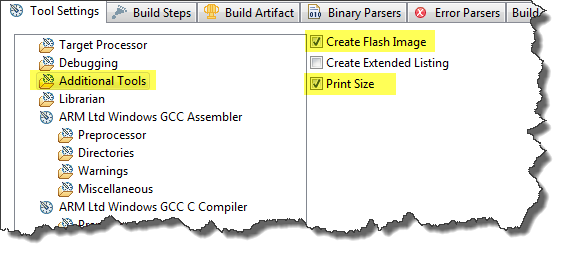
I described in earlier posts how to enable GNU build tools to generate hex/bin/S19 files, or to write the code size to the console view. That works fine for me. But then I received a project were obviously this does not work: even with the project settings configured properly, there is no S19 file, and no code size printed. What’s wrong?

Additional Tools in ARM GNU Eclipse Panel

Additional Tools in ARM GNU Eclipse Panel

Continue reading

CMSIS-DAP with IAR and the KL25Z Freedom Board

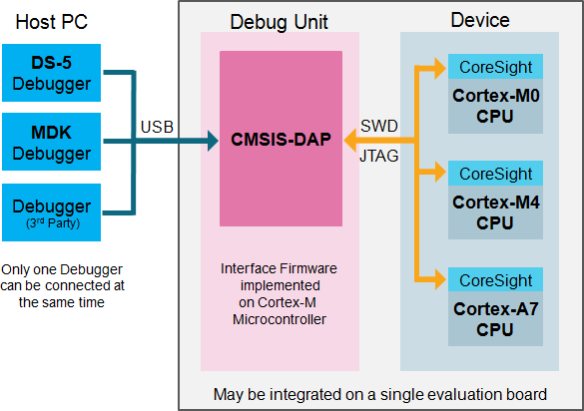
Beside of USBDM, there is another Open Source implementation of a debug interface for the Freedom Board OpenSDA: CMSIS-DAP.

CMSIS-DAP stands for ‘Cortex Microcontroller Software Interface Standard – Debug Access Port’) has been published by ARM Inc. With this, there is an open source alternative to proprietary implementation (e.g. P&E OpenSDA or Segger OpenSDA).
Beside of the ARM MDK IDE, CMSIS-DAP is supported by Coocox and IAR. And IAR is what I’m using in this post.

Continue reading

Red Suite 5: Eclipse Juno, Processor Expert and unlimited FRDM-KL25Z

❗ UPDATE: Code Red Technologies have been acquired May 1st 2013 by NXP, see this press release. According to this, they will not continue to support non-NXP architectures after May 2014. 😦

You probably know this already: I’m a fan of Eclipse, Processor Expert and the Freedom board. As for tool chains I use CodeWarrior for MCU10.x (Eclipse based, 64 KByte free limit) and IAR (32 KByte limit) with the Processor Expert Driver Suite.

And I have added a new Eclipse based solution: Red Suite 5 from Code Red Technologies. They released a new Red Suite 5 (v5.2.2 build 2108) which caught my attention when reading the release notes:

  1. Eclipse Juno SR2: New Eclipse Look & Feel 🙂
  2. Added integration for Processor Expert 🙂 🙂
  3. Non-expiring 128k (!!!) limit when used with the Freescale FRDM boards 🙂 🙂 🙂
Red Suite 5 Eclipse Startup

Red Suite 5 Eclipse Startup

Continue reading

text, data and bss: Code and Data Size Explained

In “Code Size Information with gcc for ARM/Kinetis” I use an option in the ARM gcc tool chain for Eclipse to show me the code size:

   text       data        bss        dec        hex    filename
 0x1408       0x18      0x81c       7228       1c3c    size.elf

I have been asked by a reader of this blog what these item numbers really mean. Especially: what the heck is ‘bss’???? 🙂

Continue reading

Decoding S19 Files

I’m recently dealing again with S19 (S-Record) files. I can easily generate S19 files from my ARM .elf files, but what I need is a simple decoder of the file format.

The good thing is: such a decoder is provided with CodeWarrior for MCU10.x 🙂

That capability is built into the Decoder.exe which is delivered with the Freescale S08 (or S12) tool chain, and is located inside the MCU\prog folder:

Decoder.exe inside MCU prog Folder

Decoder.exe inside MCU prog Folder

Continue reading

Compiling C Files with GNU ARM G++

If I want a C++ project for my KL25Z Freedom board, I select C++ during the project creation:

C++ Project Creation for GCC

C++ Project Creation for GCC

This creates a gcc C++ project with all the needed settings.

This worked fine until I added a *.c file to my project which had code in it which was not accepted by the C++ compiler. Wait! Should the *.c not be compiled in C mode, as I was used to with other compilers? It turned out that things are different with gcc (or g++) :-(: the *.c files in my project are compiled in C++ mode. So the question is: how to compile in C mode with the ARM g++ compiler?

Continue reading

mbed for the Freedom Board

I knew about mbed already for some time: watching students using it for an NXP enabled board. Pretty cool stuff: mbed is an online IDE and compiler with tons of software libraries for the supported platform. So I was dreaming to have something like this for my own boards like the Freedom board. But because mbed only supported two dedicated NXP boards, that was a road block.

But then mbed announced recently that the mbed SDK is open source. Wow, that is interesting! And finally the announcement last week: mbed supports the KL25Z Freedom Board. Now they have my attention :-).

Continue reading

Switching Processor Package in Processor Expert

When I create a new project for the KL05Z with Processor Expert, then it shows up as 48 pin LQFP package in the project:

48pin LQFP Package in Components View

48pin LQFP Package in Components View

However, when I look at my board, it has a KL05Z32 in a LQFP package with 32 pins:

FRDM-KL05Z Board

FRDM-KL05Z Board

Continue reading

Tutorial: Using the ARM CMSIS Library

One of the great advantage of using an ARM core as on my FRDM-KL25Z board is that I can leverage a lot of things from the community. And one big thing around ARM is CMSIS (Cortex Microcontroller Software Interface Standard). It is an industry wide software library for the ARM Cortex microcontroller. Using the CMSIS libraries and interfaces will make it easier to port applications within the ARM Cortex family.

CMSIS Version 3 Block Diagram (Source: Arm.com)

CMSIS Version 3 Block Diagram (Source: Arm.com)

Continue reading