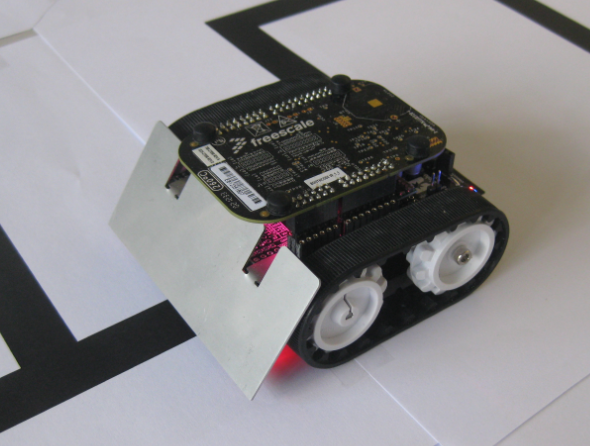
Finally I have found some time over the past week-end to enhance my Zumo robot. After I had my line following robot based on the Pololu Zumo chassis and the FRDM-KL25Z, I thought it should be easy and logical to solve a maze. Logical: yes. Easy: not that much. In fact it took me longer than expected. As always, there are a lot of tiny and important problems to solve (the maze alone was easy 🙂 ).
Tag Archives: FreeRTOS
FreeRTOS on the FRDM-KL05Z Board
There is now an example project available on GitHub which runs FreeRTOS on the FRDM-KL05Z board:
Editor Templates in Eclipse
Eclipse is a good IDE. At a first glance, it does the job. Good enough. At least for myself, I was not that much excited when I used it the first time. I came from the Microsoft Visual Studio world, and have used many other proprietary IDE’s. So Eclipse was just ‘yet another one’. But what Eclipse makes really great is the incredible wealth of functionality which is not visible right away. Yes, this is the same for any other software tool: it takes time to explore, and once you know things well, you do not want to switch or even consider something different. Same for me.
The other thing is: after some time, I get used to things, and I do not appreciate it that much any more. Only until someone reminds me that maybe things are not that well-known? This is what happened to me two days ago: I did some editing in Eclipse, while a colleague was watching me doing this. Then he said something like this
“Hey, what did you do? What was that?!? How did you do that?”
I do not remember his exact words, as I was surprised as well. I did not do anything special? Kinda standard Eclipse thing. Well, maybe not.
Pololu Line Following Robot with Freedom Board
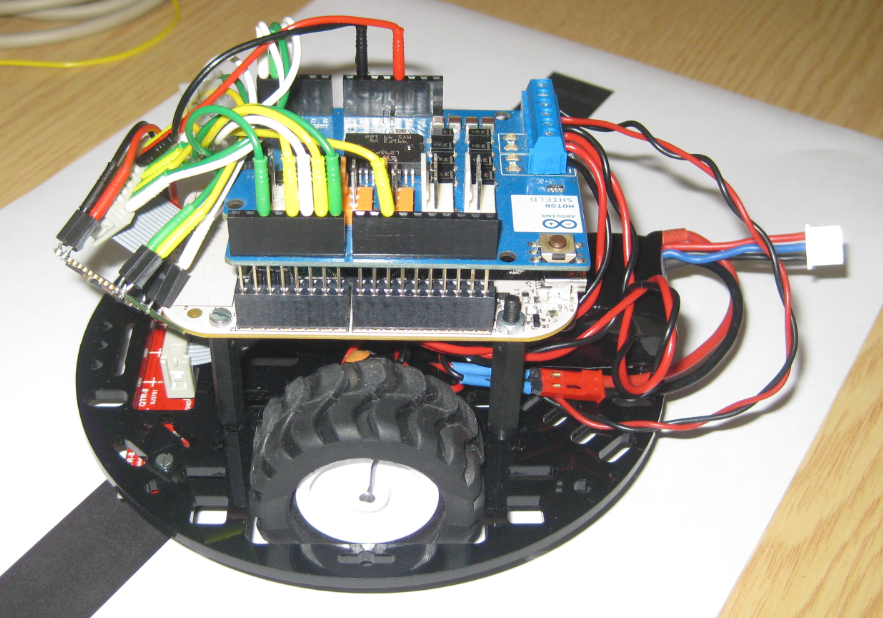
Because my first line following robot was this week at the Embedded World conference in Nürnberg, I have constructed another one around the Freedom FRDM-KL25Z board. It is based on Pololu part items and the Arduino motor shield, plus using a Bluetooth module I have used in an ealier post.
USB MSD Host for the Freedom Board
Sometimes things take longer than anticipated. And this is definitely the case for my USB MSD Host project where I wanted to use a USB memory stick with the Freedom FRDM-KL25Z board.
But finally, I have things working. At least most of the time ….
Zumo Line Following with FRDM-KL25Z
With the Zumo I have a base platform for cool robotics applications. So why not build a line following robot with this? Especially as Pololu offers a reflectance sensor array for it. The result is: I have a line following robot 🙂
It turned out that things were not working out of the box with the FRDM-KL25Z board. So if you want to do the same thing, here are some tips how to make it working with the Freedom board.
Tutorial: IAR + FreeRTOS + Freedom Board
Maybe Eclipse is ‘too much’, and you are looking for something different? The cool thing with Processor Expert is that while this is Eclipse based, you can use it easily with other tool chains like IAR Embedded Workbench. So you have the choice, and I have explored things a little with porting FreeRTOS for Cortex-M0+ to IAR :-).
In this tutorial I’m showing how use IAR with FreeRTOS and the Freedom FRDM-KL25Z Board, using Processor Expert components.
FRDM-KL25Z with the Arduino Motor Shield
The great thing with the Freedom FRDM-KL25Z board is its compatibility with Arduino Shields: a great set of board available at very reasonable prices. I had my hands on the Adafruit Data Logger shield, and now it was time to use the original Arduino Motor Shield R3.
A Generic I2C High Level Driver
I’m working with the I2C bus recently a lot. I’m using it in a project to reverse-engineering skimming (credit card fraud) devices. I needed to improve one of my applications for the lecture classes where a MCF52259 is communicating with a TWR-LCD display over I2C. And I want to add RTC (Real-Time-Clock) capabilities to my Arduino Data Logger Shield which requires I2C.
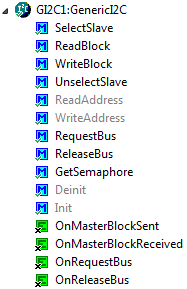
The same time I want to have things working with ARM Cortex-M4 and M0+ devices. And here the challenge started: using the I2C_LDD (Logical Device Driver) Processor Expert components for the ARM Kinetis devices is definitely not simple and easy. I want to use my software compatible for both the ARM cores and say for S08 and ColdFire cores. So what I ended up is to write a ‘generic’ I2C driver on top of the low level Processor Expert components: named GenericI2C.
ARM Cortex-M0+ Interrupts and FreeRTOS
“Anything that can go wrong, will go wrong”.
strikes again. Well, the modified version of it:
“Anything that can go wrong, will go wrong, but it will wait until it really, really goes wrong”.
It is always amazing to see that systems having a fundamental flaw, they can work for a long period. Only that on day X my application crashes. And when found the problem, I’m wondering how in the world it was *ever* working with that bug in it :-(.