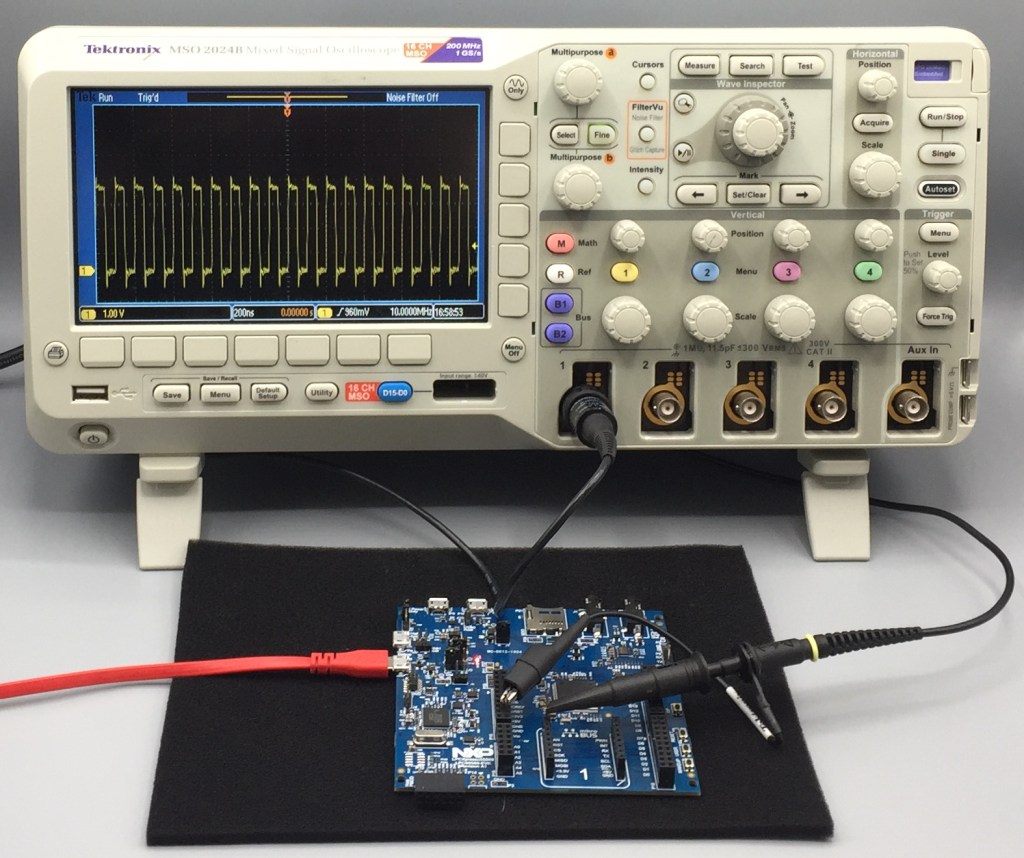
Investigating ARM Cortex® M33 core with TrustZone® – running TrustZone® example projects in MCUXpresso IDE

Last week I wrote about why we need the TrustZone® security extension for ARMv8-M. There are software use-cases where it can be very helpful to partition the software into 2 separate worlds, secure and non-secure. TrustZone® acts as the gatekeeper between these two worlds and manages how the core transitions between the worlds. The ARMv8-M architecture introduces two new States for the core – secure and non-secure. Cortex® M33 core (and M23 core also) is implemented to ARMv8-M standard and of course supports the two new states.
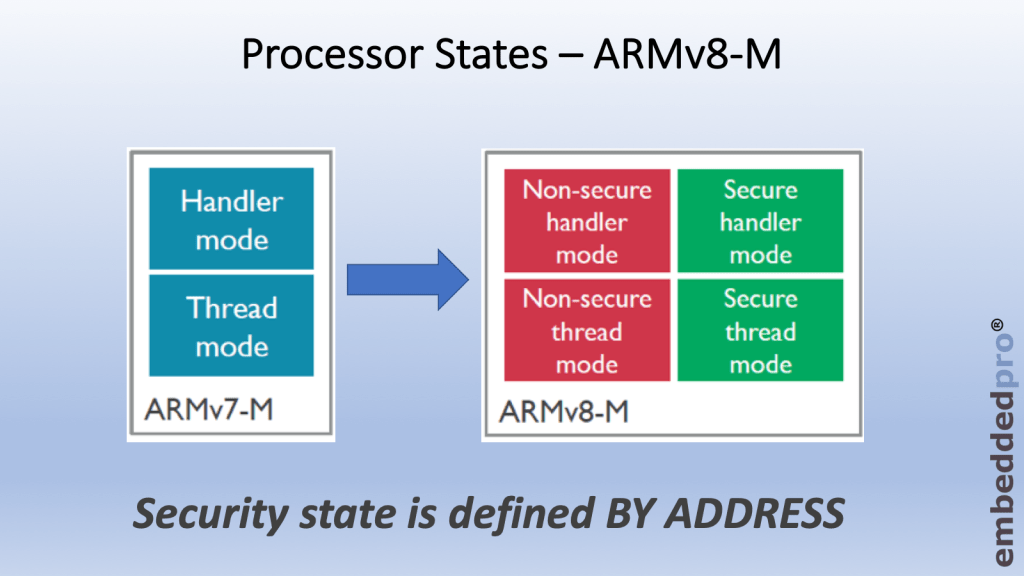
ARMv8-M architecture introduces 2 states for the core – secure and Non-secure
Continue reading

Investigating ARM Cortex® M33 Core with TrustZone® – What is TrustZone® anyway?

After the Getting Started material from the previous weeks, today we are ready to investigate TrustZone®. We all remember TrustZone® – it is that magic piece of embedded IP that miraculously solves all of our IOT security problems – right? It’s true that TrustZone® is an embedded component related to security, but not in the way that you think.

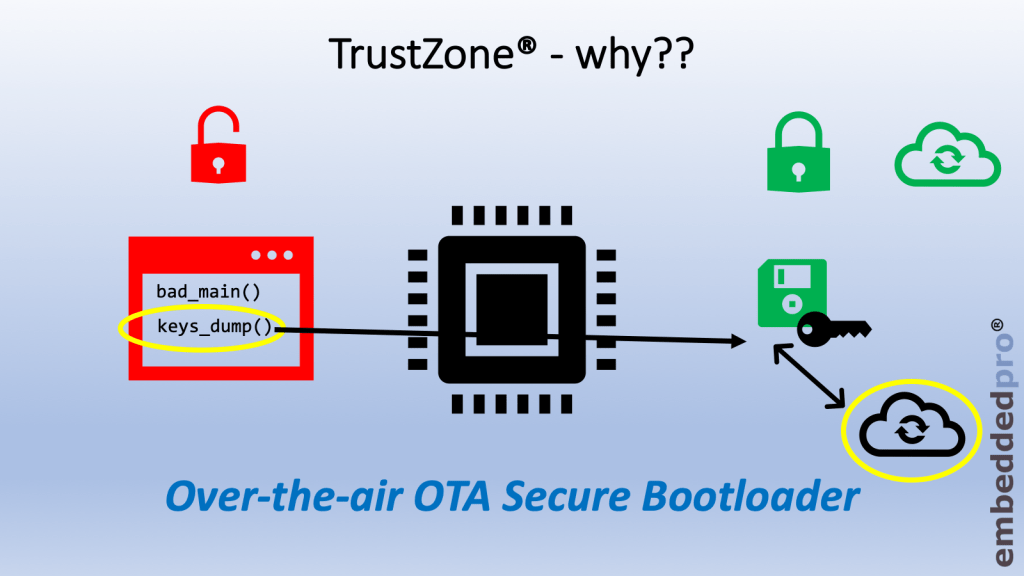
Non-trusted software can dump out our keys to a cloud server hosted by malign third-party

Before we get stuck into all the fancy technical details, let us at first stop and think about some of the challenges that we face with embedded systems, and what can be done about them. This week I simply address the topic: What is TrustZone® and Why do we need it??

Continue reading

Investigating ARM Cortex® M33 core with TrustZone® – Using the Clocks Config Tool

Clocks. I’ve always found the clock setting of a microcontroller one of the hardest things to get right during my embedded career. If I re-use the clocks setup from the development board it is easy. But if the development board runs from a crystal and I want to use the free-running internal clock, or if I change to a different frequency crystal (and keep the same PLL output frequency) it always gets difficult. To be honest I’ve developed some projects early in my career and never been 100% certain at what frequency the core, flash and peripherals are running.

That’s not good.

The Config Tools within the MCUXpresso brand have greatly simplified setting up the pins, clocks, peripherals (and next week – Trusted Execution Environment 🙂 ) on NXP microcontrollers. So I’m going to quickly show you how to set up 3 different clock arrangements, and output the main clock to an output pin named CLK_OUT.

Continue reading

Investigating ARM Cortex® M33 core with TrustZone® – Using the Pins Config Tool

Well let’s face it, modern microcontrollers are complicated. The User Manual for the LPC55S69 has 1148 pages (Rev 1.3) and that does not include any of the electrical characteristics – see the Datasheet (129 pages) nor does it include the details around the core or instruction set (see ARM documentation) . So there is a lot of technical information to read, and don’t get me started on the pin multiplexing… Well actually, do get me started on the pin multiplexing because that is my focus this week.

This week I turned my attention to writing a very simple example project in MCUXpresso IDE to run on the ARM Cortex® M33 core inside the LPC55S69. As in previous weeks I am again using the LPC55S69-EVK from NXP. My plan is to use this board every week but I have learned recently a few details about a new ultra-low-cost board. It’s going to be AMAZING and I’ll share more details with you when I can.

Continue reading

Investigating ARM Cortex® M33 core with TrustZone® – Setting up your environment and creating your first project with MCUXpresso IDE

This is the second of my 17-part video tutorial series investigating the ARM Cortex® M33 core with TrustZone® security extension. My preferred platform for this investigation is the LPC55S69 from NXP, and of course it is necessary to have a development board and IDE. So I’m using the LPC55S69-EVK with NXP’s MCUXpresso IDE and the MCUXpresso Software Development Kit (SDK).

This week the video is really low on theory, but high on practical, step-by-step information to get started with these tools. Maybe you are similar to me, and make the same mistake every time?? I get the self-assembly furniture home from the store, or open the box containing the new development board and just get started. At some point it doesn’t work properly and that’s the time I must read the supporting information.

Well, with this video I show you beginning-to-end in just over 10 minutes, and you won’t need to refer to any other material.

During the video I show you the following steps:

Continue reading

Investigating ARM Cortex® M33 core with TrustZone® – Unboxing and Getting Started

Hi, I’m Mark from embeddedpro® in the United Kingdom and Erich’s allowed me to be a guest blogger here on mcuoneclipse. At many industry events, trade shows and conferences I’ve seen and given presentations about TrustZone®, but have not found tutorials or practical information online.

So I’m creating a 17 part video tutorial series (it will be published weekly here) investigating the ARM Cortex® M33 core with the TrustZone® security extension. Each week from now until the end-of-year holidays I will let you know what I’ve found out with a blog here, and a video blog on youtube. My friends at NXP have given me a LPC55S69-EVK board as the basis for my experiments:

LPC55S69-EVK (linked from nxp.com)

This is my first quick post showing the unboxing of the LPC55S69-EVK and the out-of-box experience.

Continue reading