Eclipse Debugging with Strings – Part 2

Maybe a better title for this post would be “Eclipse Debugging with Strings Attached’? Digging a bit more into the domain of string debugging, things are not always the way I wish they are.

I’m using here CodeWarrior for MCU10.2, which is based on Eclipse 3.6. Let’s use the following piece of code with the ARM Cortex-M4 Kinetis K60 core and the Freescale ARM compiler:

char buf[] = "abcd";
char *p = &buf[0];

unsigned char ubuf[]="ABCD";
unsigned char *up = &ubuf[0];

signed char sbuf[]="1234";
signed char *sp = &sbuf[0];
Continue reading

Please Check Your License

The good thing with many vendors is: they offer development tools free of charge. And the limitations are typically reasonable for many projects. The Eclipse based CodeWarrior for MCU10 is not an exception: it comes in a free (‘Special’) Edition which allows up to 128 KByte of code to download for my ARM/Kinetis projects.

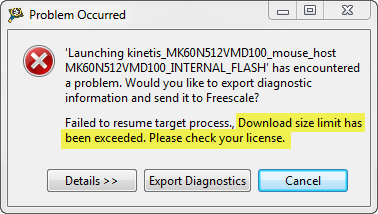
But, when I tried to debug an Example I have downloaded from the web, I get this dialog:

“Download size limit has been exceeded. Please check your license.”

Download Size Limit Has Been Exceeded

Download Size Limit Has Been Exceeded

Continue reading

A Shell for the Freedom KL25Z Board

I’m a big fan of physical UART/RS-232 ports on boards. So I was somewhat disappointed not to see a serial 9pin connector on the Freedom KL25Z board. But it is perfectly understood that for this price costs are critical, and a serial header or connector is pushing the budget for that board very likely out of the water. Still, I want serial connectivity for my applications.

Freedom Board with RGB LED

Freedom Board with RGB LED

Continue reading

Virtual COM/USB CDC for OSBDM/OSJTAG

Many new notebooks do not have a serial port any more: everything is USB. This can lead to problems (see USB or not: CDC with Processor Expert) as many embedded targets  use normal RS-232. In my classes I’m using the Tower boards: some Tower boards have an on-board 2 pin RS-232 header, e.g. the Tower TWR-MCF52259. Others like the TWR-K60N512 use the added TWR-SER board. The Tower boards have as well a USB capable S08JM60 which is used for debugging (OSBDM/OSJTAG), so why not using the OSBDM microcontroller as Serial-to-USB gateway?

Continue reading

FatFs with Kinetis

An SD (Secure Digital) Card interface is kind of standard for many applications today: it provides a lot of memory at a reasonable cost. Still, I need a software stack for it, up to the level of a file system. So far I was really happy with using FatFs: an open source FAT file system provided by Elm-Chan. I’m using the FatFs Processor Expert component already in multiple designs. What was missing: a port to the Freescale Kinetis ARM Cortex-M4 family of processors.

Continue reading

There is a Time and Date for both Worlds

The Kinetis ARM Cortex-M4(F) is a wonderful machine: a 32bit architecture, plenty of FLASH and RAM, an ideal play field. I love the Kinetis Tower boards, and even more the Freedom board which has an ARM Cortex-M0+ on it. I have a lot of projects on S08, S12 and ColdFire at the university, and they are all using a lot of Processor Expert components. Processor Expert is such a great productivity tool: having software in components allows easy software re-use. With Processor Expert abstracting from the hardware, I can easily port my applications to new boards and processors. Well, until Processor Expert changed for Kinetis :-(.

Continue reading

FreeRTOS with GCC, Cortex-M0+ and Kinetis KL25Z Freedom Board

Yesterday was my ‘lucky day’: My Kinetis-L Freedom board arrived :-). This board is really nice and features the KL25Z from the recently announced Kinetis L Family. And guess what is the first thing I want to flash on that processor? Yep: some FreeRTOS tasks. But to get there, a few important things have to be sorted out:

Continue reading

There is an ARM to Trace

When I added ‘support for ARM/Kinetis‘ to my bucket list in my Percepio+Trace post, I knew it will not be straight forward. But it was a lot harder than I thought. I had to burn many week-end hours. But finally I have Percepio Trace with FreeRTOS up and running for Kinetis and ARM Cortex-M4 with CodeWarrior for MCU10.2 :-).

Continue reading

Device is secure?

It is one of these long weekends which allow to catch up on many things. One thing I finally completed was the move to FreeRTOS V7.1.1. With this I did some tests using the Tower boards, including the Kinetis one. So I have rebuild my Kinetis K60 application and was ready to flash the device. But then to my surprise I got this dialog:

Device is secure. Erase to unsecure?

Device is secure. Erase to unsecure?

Continue reading