Processor Expert Maxim I2C RTC for the Arduino Data Logger Shield

There was one part missing to complete the software support for my Arduino DataLogger Shield on top of my FRDM-KL25Z Freedom board: support for the Maxim DS1307 RTC (Real Time Clock).
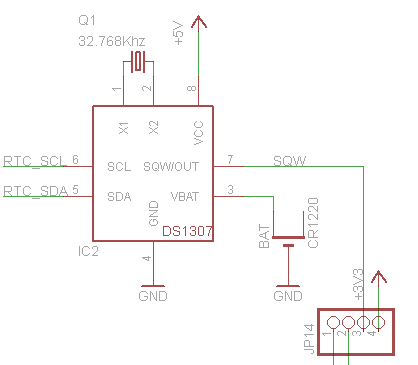
DS1307 on the Adafruit Data Logger Shield

DS1307 on the Adafruit Data Logger Shield (Source: http://www.ladyada.net/make/logshield/design.html)

Things got delayed a bit, as I first needed to get the I2C infrastructure up and running (see this post). But finally, I have things working :-). I proudly present: RTC_Maxim!

Continue reading

Debugging Hard Faults on ARM Cortex-M

It is as bad as this: my application stopped in an unhandled interrupt service routine:

Cpu_Interrupt
Cpu_Interrupt

That does not tell much. I’m using Processor Expert generated code, and with this all my ‘unhandled’ vectors are pointing the same handler:

Continue reading

Arduino Data-Logger Shield with the FRDM-KL25Z Board

One success factor of the Arduino platform is the broad availability so-called ‘shields’: hardware plugin-modules which extend the capability of platform. Shieldlist.org currently lists 288 different shields available! Clearly, Freescale wants to benefit from that ecosystem with the Freedom FRDM-KL25Z board which features Arduino compatible headers. Time to use the Freedom board with an Arduino shield :-).

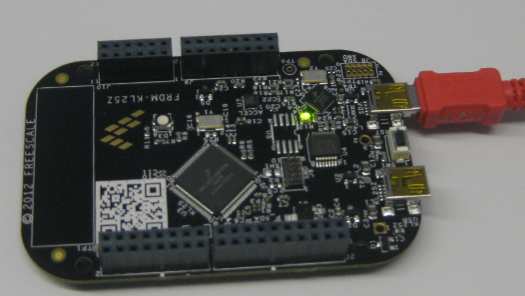
Data Logger Shield on Top of Freedom Board

Data Logger Shield on Top of Freedom Board

Continue reading

USB Component Splitted and Updated

Checking the download statistics of my Processor Expert components on http://www.steinerberg.com/EmbeddedComponents/, there is a clear winner: FSL_USB_Stack 🙂

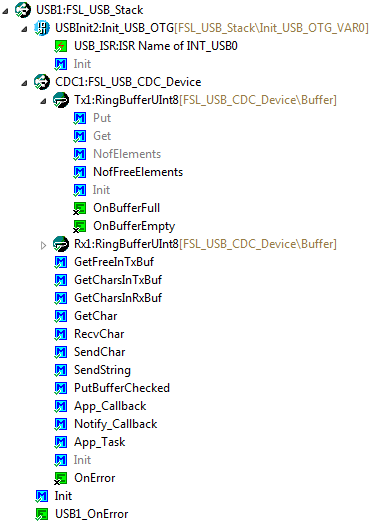
It has been a while I presented that universal USB CDC component in this blog. The component has received a larger re-architecture, I wanted to support more than just USB CDC. For this, the CDC part is now present in a separate sub-component:

FSL_USB_Stack with Sub-Components

FSL_USB_Stack with Sub-Components

Continue reading

Tutorial: Bits and Pins with Kinetis and the FRDM-KL25Z Board

In “Optimizing the Kinetis gcc Startup” I stripped down the fat of my startup code. Now time to add some useful things. And what does a microcontroller like the KL25Z on the Freedom FRDM-KL25Z board have: Pins! And this means I have bits to set and read :-).

FRDM-KL25Z Board

FRDM-KL25Z Board

Continue reading

Getting Help on Processor Expert Components

That might be an obvious thing for me, but recent questions of readers of my blog let me think that it is not that obvious: How to use a Processor Expert component? How to find example code?

There is the context menu entry ‘Help on Component’ on the component itself, both in the Components Library view and on the component inside the project:

Continue reading

Speeding up the Debug Launch in CodeWarrior

Whenever I do a debug launch in the Eclipse based CodeWarrior, it takes some time until actually I’m ready to step through my code on the target. Yes, a good part of that is by Eclipse. But another part is that Eclipse helps me to do stupid things (which is a good thing). But say if I know what I’m doing, I could remove some of that safety belts and still doing fine. But only if I know what I’m doing.

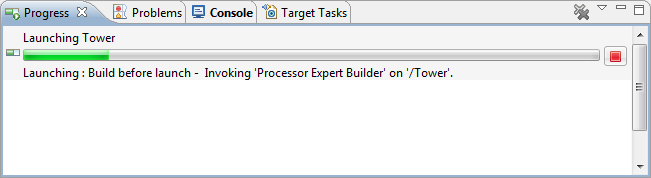
A good indicator where Eclipse is spending time is to have a look in the Progress View:

Progress information during launch

Progress information during launch

It shows an interesting information: ‘Build before Launch’….

Continue reading

Tutorial: printf() and “Hello World!” with the Freedom KL25Z Board

Sometimes I show to much in a tutorial: only writing something to the UART? Sounds boring, so why not adding tasks, LEDs and a full shell implementation to the mix as in this post? Yes, definitely too much to start with at the beginning :-(. So less is more, and if it is just about the UART. And I promise: it is doable with around 50 lines of application code :shock:.

AND: I admit, this post title is a trap ;-). It is not about printf(). But it *is* about using the UART on the KL25Z Freedom board and to do things like printf(), and even more. Trust me. It is about how to write *and* read from the UART. While I’m using here the Kinetis-L ARM Cortex-M0+ KL25Z Freedom board, it is applicable to any other Kinetis device.

Continue reading

Removal of Processor Expert for a Project

Yes, I’m using Processor Expert *a lot*. But there might be reasons to go without it. Because then I really want to do it the hard-hard-hard core way. Or maybe because I have configured my system, and want to freeze my code. And nothing prevents me to do it ‘my way’.

In any case, it is easy to transform a CodeWarrior Processor Expert project, and then decide to remove that technology from it, and go further with the ‘traditional’ technology.

Continue reading

Tutorial: USB CDC with the KL25Z Freedom Board

Question: What to do on a rainy Sunday?
Answer: Having fun with USB and the KL25Z Freedom board! :-).

In “A shell for the Freedom board” I used the UART-to-USB OpenSDA capability of the KL25Z Freedom board: The KL25Z processor uses the OpenSDA K20 microprocessor as Serial-to-USB converter. But this only works because of the P&E OpenSDA USB CDC (Communication Device Class) implementation. If I create my board without OpenSDA, I need a different approach: I want to do USB CDC with the KL25Z :twisted:.

USB CDC Device on COM22

USB CDC Device on COM22

Continue reading