By default, when debugging an embedded application, the target usually stops at main():

stopped in main
That’s usually fine, but what if I want to debug the code out of reset?
By default, when debugging an embedded application, the target usually stops at main():
stopped in main
That’s usually fine, but what if I want to debug the code out of reset?
The ARM DWT (Data Watchpoint and Trace) is an optional feature of the ARM-Cortex-M, and many Cortex-M3, M4 and M7 devices have it implemented. With it comes a cycle counter which counts the cycles spent. In Cycle Counting on ARM Cortex-M with DWT I described an approach how the application on the target can access the cycle counter.
The MCUXpresso IDE shows that cycle counter in the Eclipse Registers view:
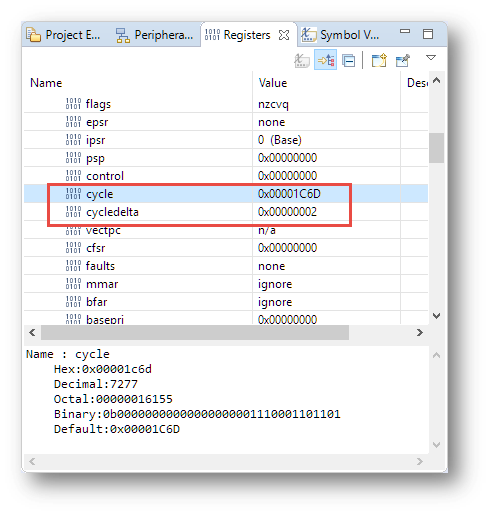
Cycle Counter in Register View
FreeRTOS seems to get more and more popular, and I think as well because more and more debugger and Eclipse IDE vendors add dedicated debugging support for it.

FreeRTOS Threads in Eclipse
Eclipse for C/C++ (CDT) offers two different ways to get out of a debug session: Terminate and Disconnect:

Terminate and Disconnect
The terminate and disconnect behaviour is not standardized, and varies between Eclipse distributions and debug connection. This article is about how things are handled in MCUXpresso IDE, and how I can influence the behaviour.
I’m using Eclipse based IDE’s to develop and debug my embedded applications. This works great, as Eclipse has all the necessary tools to edit, build and debug it. But when it comes just to download/flash a binary to the board, then things are pretty much specific to the tools used. With the advent of the new MCUXpresso IDE, here is how that Eclipse IDE can be used for this.

LinkServer GUI Flash Programmer
 MCU on Eclipse