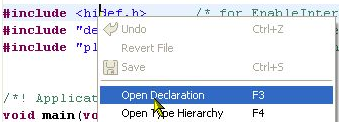
One of the greatest features in Eclipse is the Indexer: it parses automatically my code in the background. It creates all the needed information so I can browse around my sources. I can use the Open Declaration context menu in the source code:
Tracing FreeRTOS with a Hardware Probe
Using an RTOS is an excellent thing: it provides services and allows to scale my application. But it adds complexity. With many tasks, queues and semaphores it is hard to have an overview what is going on. To get visibility, Martin Bucher has developed in a bachelor diploma work the FreeRTOS Trace Probe. Continue reading
Copy my Project
I’m using Subversion to keep track of changes in my eclipse MCU10 projects. That allows me to get back in time without the need to make copies of my project. But sometimes I do need to make a copy of my project: because I want to use a project as a base and then do something different with it. To make a copy of a project is simple, but requires some more steps if I’m using Target Tasks. Here is how I do this… Continue reading
Dissection of MCU10 Projects
Creating an eclipse managed make project with MCU10 is easy: Starting the wizard with File > New > Bareboard Project and after a few clicks I have a project. I don’t need to worry about all the files in the project structure, until……..well, until I need to put the files into a VCS.
USB CDC, reloaded
The Processor Expert USB CDC component posted in USB or not: CDC with Processor Expert has found many friends :-). A new version is available for download here with examples. It adds a bunch of new features and makes many things: simpler dependencies and setup, generation of an easily accessible cdc.inf and availability of error hooks. I have it running now with the TWR-MCF52259 and the DEMOJM (MCF51JM128 and S08JM60). Continue reading
No rule to make target
This error message is something I see nearly every day in the Problems View:
mingw32-make: *** No rule to make target ….
USB or not: CDC with Processor Expert
I had a PREN student showing up into my office. He wanted to choose a microcontroller for that project. One requirement put on the table was “it needs USB”. Well, I asked why USB is required. I was not surprised by the answer: “to use USB instead of RS-232”. Wow. So what he really wanted was USB CDC (Communication Device Class). Yep. Most notebooks today have no serial COM port (see “Processor Expert Configurations“). But because “USB is serial” does not mean “USB CDC is simple”. Nope. USB is not simple. But it can be with Processor Expert.
Shared Files maintained by Processor Expert
As outlined in Quickstart for Processor Expert in Eclipse, it is easy to create a new Processor Expert project. There are three shared files which are maintained by Processor Expert. At the same time I need to change them with my code. So how does this work, and how can I configure it to my needs?
Quickstart for Processor Expert in Eclipse
Ok, you are probably new to Eclipse, and want to do the fun part: Creating an Eclipse Processor Expert project in CodeWarrior for MCU10.2. Cool! Here are some steps and tips to make it smooth from the beginning…
Drag&Drop in Processor Expert
I have that wonderful project in MCU10.2 with Processor Expert using Embedded Components. It took me a while to carefully configure the settings, and now it works like a charm. I have another project and need the same components and settings in there. But how?

