FreeRTOS with GCC, Cortex-M0+ and Kinetis KL25Z Freedom Board

Yesterday was my ‘lucky day’: My Kinetis-L Freedom board arrived :-). This board is really nice and features the KL25Z from the recently announced Kinetis L Family. And guess what is the first thing I want to flash on that processor? Yep: some FreeRTOS tasks. But to get there, a few important things have to be sorted out:

Continue reading

There is an ARM to Trace

When I added ‘support for ARM/Kinetis‘ to my bucket list in my Percepio+Trace post, I knew it will not be straight forward. But it was a lot harder than I thought. I had to burn many week-end hours. But finally I have Percepio Trace with FreeRTOS up and running for Kinetis and ARM Cortex-M4 with CodeWarrior for MCU10.2 :-).

Continue reading

CDE RTOS Hacking: Show it as an RTOS component

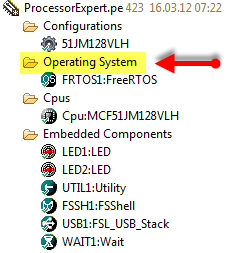
Technically, a normal user component can implement any RTOS. This is what I did with the Micrium MicroC/OS-II component. That way the component shows up in the ‘Embedded Components’ group. But how to make it showing up as RTOS component inside the ‘Operating System’ group as the FreeRTOS component? What I want is this: to show the RTOS component under the ‘Operating System’ group of my project:

FreeRTOS in the Operating System Group

FreeRTOS in the Operating System Group

Continue reading

CDE Hacking: *.inc Files

In my previous post  I mentioned the Drivers\Common folder which has ‘include’ files. These files are maintained automatically by the Component Wizard. But what is the purpose of these files?

The Common Folder has *.inc files which are included in the driver as ‘function’ header. The .inc file contains documentation about the function and parameters for that function.

Continue reading

The Making Of RTOS Processor Expert Components

OK, I think this topic is a very special one, and probably not of interest of many folks out there. Or how many want to create a Processor Expert Plugin for an RTOS? Well, I did this. And I think that topic might be very controversial too, especially for all the RTOS vendors out there :-). The thoughts expressed here about creating Processor Expert components do not only apply for an RTOS, but as well for any other ‘complex’ software or stack. So if you are interested about the ‘behind the scenes’ of creating Processor Expert components, especially in the context of an RTOS, then read on ;-).

Continue reading

Tutorial: FreeRTOS on DEMOJM

If you are new to Processor Expert in MCU10, and new to FreeRTOS, then you need to learn two new things in parallel the same time. That might be overwhelming. But don’t worry: if you do things step by step and slowly the first time, this much easier than you might think. This tutorial shall help you with this.

This is a step-by-step tutorial about how to create a project with CodeWarrior for MCU10.2, Processor Expert and the DEMOJM board. The goal is to create a project from scratch with two tasks blinking an LED. This tutorial uses the DEMOJM board, but in practice any other ColdFire/Kinetis/S08 board can be used as well.

Continue reading

Percepio FreeRTOS+Trace V2.2.2 released

Percepio has released a new V2.2.2 library of FreeRTOS+Trace (see Tracing with FreeRTOS+Trace from Percepio). The new release comes with many improvements. The trace recording is optimized for more efficient recording and longer trace with the same amount of memory.

Note: Because the trace data structure is changed and optimized, I need the latest tool on the PC/host from http://www.percepio.com.

I have updated the Percepio Processor Expert component to generate and use the new trace library V2.2.2. This includes the new settings in the component properties as shown below:
Continue reading

FreeRTOS V7.1.1 released

FreeRTOS V7.1.1 was released beginning of May 2012. Finally I had some week-end time to integrate the changes and upgrade the Processor Expert component for it. V7.1.1 comes with smaller and larger changes. This includes maintenance and better support for various ports. One change is the removal of CLI from the original FreeRTOS distribution, an extra port macro and one trace hook macro.

Continue reading

Tracing with FreeRTOS+Trace from Percepio

As shown in Tracing FreeRTOS with a Hardware Probe: I have a nice hardware probe to trace out events from my application. But what about to use the target memory as trace buffer? New devices have much more on-chip memory, so this could be an attractive option. That was on my list of future extensions, but then the news came in: Percepio announced their collaboration with FreeRTOS+Trace: exactly what I needed!

It is using the same concept as the FreeRTOS Trace Probe: the trace hooks provided by the FreeRTOS API. But instead streaming it off the target as with the FreeRTOS Trace probe, it is using a RAM buffer on the device. The real cool thing is: the Percepio trace viewer is very, very nice!

Continue reading

Tracing FreeRTOS with a Hardware Probe

Using an RTOS is an excellent thing: it provides services and allows to scale my application. But it adds complexity. With many tasks, queues and semaphores it is hard to have an overview what is going on. To get visibility, Martin Bucher has developed in a bachelor diploma work the FreeRTOS Trace Probe. Continue reading