Percepio FreeRTOS+Trace V2.2.2 released

Percepio has released a new V2.2.2 library of FreeRTOS+Trace (see Tracing with FreeRTOS+Trace from Percepio). The new release comes with many improvements. The trace recording is optimized for more efficient recording and longer trace with the same amount of memory.

Note: Because the trace data structure is changed and optimized, I need the latest tool on the PC/host from http://www.percepio.com.

I have updated the Percepio Processor Expert component to generate and use the new trace library V2.2.2. This includes the new settings in the component properties as shown below:
Continue reading

Killing Me Softly: Zombies and Debugger Engines

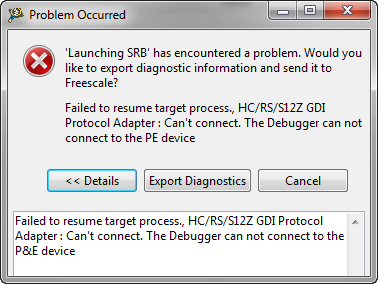
I’m stressing the CodeWarrior debugger a lot: having multiple boards attached, debugging things in parallel, switching and unplugging boards all the time. I have my eclipse IDE running for several days and nights (up to a week or more), with constantly suspending and resuming and switching networks. And sometimes it is my fault (see Device is Secure?). But well, sometimes the CodeWarrior debugger has a problem too. Luckily, a simple trick gets things back on track.

Continue reading

Device is secure?

It is one of these long weekends which allow to catch up on many things. One thing I finally completed was the move to FreeRTOS V7.1.1. With this I did some tests using the Tower boards, including the Kinetis one. So I have rebuild my Kinetis K60 application and was ready to flash the device. But then to my surprise I got this dialog:

Device is secure. Erase to unsecure?

Device is secure. Erase to unsecure?

Continue reading

Dump my Device Memory

Maybe this situation is familiar to you: My embedded software stopped in the field. I am in front of it, hooked up with my laptop and debugger. And I see: indeed, it has a problem. Maybe just a one-time-thing? Maybe I do a reset and things will work as expected? Not really, according to Debugging Rules.

The thing is this: I’m in a situation which requires some deep investigation. But I do not have the time now. Or my boss, the boss-boss or the customer are standing behind me asking all the good questions for which I don’t have an answer. So in this situation it would be great if you could take a dump of the device memory, reset that board, move on and investigate what happened offline? Here are several ways how to do this…

Continue reading

Flashing with a Button (and a Magic Wand)

In eclipse and CodeWarrior for MCU10 the usual thing I do is:

  1. I have a project in my eclipse workspace
  2. I compile and build it
  3. I download and flash it to the target for debugging

If I need to program another board with the same binary, then I download it to that board too. Fine. But what if I want to skip point 1 and 2? What if I do not have or want a project? All what I have (and need) is a binary file, and I want is to flash that file to my boar. By pressing a button.

Continue reading

Watchpoints: Data Breakpoints

Sometimes my embedded application is not doing what I want it to do. I can solve many problems with normal ‘step/stop mode debugging‘: setting breakpoints, step, stop, inspect data, and so on. But not always. If a piece of code is changing a global variable unintentionally, I do not know where to set my breakpoint. Something is changing my variable, and I have no clue from where. It could be a dangling pointer, a stack overflow or something similar which I cannot track down with code breakpoints. What I need is a breakpoint on data: watchpoints!

Continue reading

Programming part of flash

In many cases I do a full erase-flash-debug cycle: I get my embedded microcontroller flash completely erased and then programmed with my application. Well, that does not work that way if I program with a bootloader. Yes, I can flash the bootloader and then load my target application with the bootloader, but that’s not the scenario I want to use in the development phase. I want to flash my application and keep the bootloader on the target. This means: I need to do erase and program a part of the memory. But how to do this?

Continue reading

Traps&Pitfalls: Overlapping Interrupt Priorities

It happens to me that I run into a really, really nasty problem. I spend hours (if not weeks) to get it resolved. Strong coffee and the problem keeps me up at long nights. I think every embedded system engineer knows what I’m talking about. Yeah, most of the time it is my fault or an oversight. But once in a while I’m convinced that I have found a real bug. Then I report it back to the vendor to fix it. I hope my report will prevent another engineers to run into the same problem. Or that I learn something else as a by-product. Oh yes….

Continue reading