Please Check Your License

The good thing with many vendors is: they offer development tools free of charge. And the limitations are typically reasonable for many projects. The Eclipse based CodeWarrior for MCU10 is not an exception: it comes in a free (‘Special’) Edition which allows up to 128 KByte of code to download for my ARM/Kinetis projects.

But, when I tried to debug an Example I have downloaded from the web, I get this dialog:

“Download size limit has been exceeded. Please check your license.”
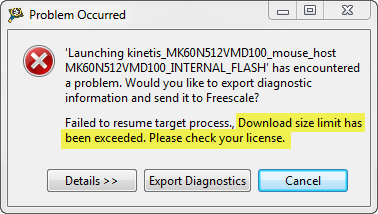
Download Size Limit Has Been Exceeded

Download Size Limit Has Been Exceeded

Continue reading

CodeWarrior Flash Programming from a DOS Shell

I can do test automation or standalone flash programming using the Debugger Shell. But this requires me to use a view inside of Eclipse. What would be nice is to do such things from a lower level: from a Windows Command window (CMD or DOS Shell). This is possible with usage of Eclipse/CodeWarrior in command line mode.

Continue reading

Standalone Flash Programmer

In Scripting, the Debugger Shell and Debugger Shell: Test Automation I was exploring how to use the Debugger Shell for automation. For my lectures at the university I need to program multiple boards with the same application. I don’t want (and need) a debugger for this: all what I need is a ‘Standalone Flash Programmer’: the ability to flash one or multiple boards without debugging.

Continue reading

Flashing with a Button (and a Magic Wand)

In eclipse and CodeWarrior for MCU10 the usual thing I do is:

  1. I have a project in my eclipse workspace
  2. I compile and build it
  3. I download and flash it to the target for debugging

If I need to program another board with the same binary, then I download it to that board too. Fine. But what if I want to skip point 1 and 2? What if I do not have or want a project? All what I have (and need) is a binary file, and I want is to flash that file to my boar. By pressing a button.

Continue reading

Programming part of flash

In many cases I do a full erase-flash-debug cycle: I get my embedded microcontroller flash completely erased and then programmed with my application. Well, that does not work that way if I program with a bootloader. Yes, I can flash the bootloader and then load my target application with the bootloader, but that’s not the scenario I want to use in the development phase. I want to flash my application and keep the bootloader on the target. This means: I need to do erase and program a part of the memory. But how to do this?

Continue reading

Scripting: The Debugger Shell, Getting started…

(This is the first in an occasional series around the scripting in eclipse and CodeWarrior. Post a comment – let me know what you think!)

Writing code should be fun, and debugging it is just a necessity because I rarely get it right the first time. Eclipse with its GUI is a great thing, and so is a command line interface. Luckily the CodeWarrior eclipse engineers have added that kind of tool for the CodeWarrior debugger: the Debugger Shell as command line debugger using the TCL scripting language. This gives me a powerful way to deal with the embedded target board: from basic access to memory, to stepping and controlling the execution up to programming the flash memory.

Continue reading

Problem Occurred: Flash programming with overlapping memory

My post in “An error occurred…”: Applied Debugging Rules gives some hints about how to isolate and solve some debugging problems. But here is a case where the tips did not help: I had this dialog with “Failed to resume target process” for my HCS08 project again:

Problem occurred
Problem occurred

Continue reading

Men In Black are back! Flashing and FX’ing…

I have mentioned in MCU10.2 released a new feature in CodeWarrior: support for the USB Universal Multilink FX from P&E Microcomputer Systems. Two Multilink FX arrived last week at the University, and finally I had my hands around it. The first thing which came to my mind when I saw the picture of the device on the P&E website: the black boxes are back!

Can I hope for a “Special FX Edition” in that box with cool sunglasses and a flash stick to erase and reprogram FLASH memory of microcontrollers? That would definitely make the flash erasing and programming easy and fast, as in the movie. 🙂
Continue reading