Reducing Code Size with gcc and EWL

If you have not noticed: the final CodeWarrior for MCU10.3 has been released on the Freescale web :-).

It comes with a few changes compared to the 10.3beta release, and one is about the library configuration. I noticed that new projects created with the wizard are around 4 KByte larger than I expect them to be. For example my rather simple application below uses 8 KByte of code, where my expectation would be in the range of around 4 KByte:

   text       data        bss        dec        hex    filename
   8644         24       1108       9776       2630    Freedom_2x16_HTA.elf

Continue reading

Zero Cost 84×48 Graphical LCD for the Freedom Board

The Freedom KL25Z board has a great price of less than $15. Adding a typical LCD usually will add a multiple of that price to the budget. But hey, there is a way to add a LCD to that board at almost no costs! With the idea that I have an old outdated Nokia phone, and the cost of a small capacitor plus some wires are considered as ‘zero’ ;-).

Say Hello from the Freedom Board

Say Hello from the Freedom Board

Continue reading

FRDM-KL25Z with the Arduino Motor Shield

The great thing with the Freedom FRDM-KL25Z board is its compatibility with Arduino Shields: a great set of board available at very reasonable prices. I had my hands on the Adafruit Data Logger shield, and now it was time to use the original Arduino Motor Shield R3.

Freedom FRDM-KL25Z with Arduino Motor Shield and Arexx Chassis

Freedom FRDM-KL25Z with Arduino Motor Shield and Arexx Chassis

Continue reading

Adding Symbols to the CodeWarrior Debugger

On the TWR-LCD, I’m using a USB MSD bootloader. In Programming part of flash I showed how to download and debug the application on top of the bootloader. But how to debug both the bootloader and the application? At the same time with CodeWarrior for MCU? The magic key is tell CodeWarrior to use ‘Other Executables’.

Continue reading

Processor Expert Maxim I2C RTC for the Arduino Data Logger Shield

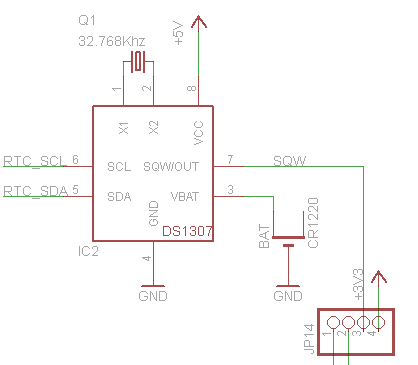
There was one part missing to complete the software support for my Arduino DataLogger Shield on top of my FRDM-KL25Z Freedom board: support for the Maxim DS1307 RTC (Real Time Clock).

DS1307 on the Adafruit Data Logger Shield

DS1307 on the Adafruit Data Logger Shield (Source: http://www.ladyada.net/make/logshield/design.html)

Things got delayed a bit, as I first needed to get the I2C infrastructure up and running (see this post). But finally, I have things working :-). I proudly present: RTC_Maxim!

Continue reading

KL25Z and I2C: Missing Repeated Start Condition

I really hate this kind of stuff: I know it should work, but it does not. I’m loosing a lot of time (hours, days, even weeks) to track it down to the root cause. Yes, I create my own bugs. Yes, there are bugs in tools, sources, libraries and components. But what many might not believe: there are bugs in silicon too :-(. If you do not believe, here is one: there is a hardware I2C problem on the KL25Z used on the Freedom board. It worked in one project, but not in another.

❗ The silicon bug described here is present on many Kinetis devices, not only the KL25Z!

Logic Analyzer attached to the FRDM-KL25Z board

Logic Analyzer attached to the FRDM-KL25Z board

So if you are facing a problem where you read 0xFF or wrong values from the I2C bus with the KL25Z, here is probably why (and how to workaround it). The problem showed up with a modified version of the Freedom Accelerometer tutorial….

Continue reading

A Generic I2C High Level Driver

I’m working with the I2C bus recently a lot. I’m using it in a project to reverse-engineering skimming (credit card fraud) devices. I needed to improve one of my applications for the lecture classes where a MCF52259 is communicating with a TWR-LCD display over I2C. And I want to add RTC (Real-Time-Clock) capabilities to my Arduino Data Logger Shield which requires I2C.

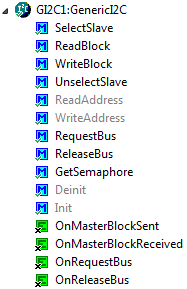
The same time I want to have things working with ARM Cortex-M4 and M0+ devices. And here the challenge started: using the I2C_LDD (Logical Device Driver) Processor Expert components for the ARM Kinetis devices is definitely not simple and easy. I want to use my software compatible for both the ARM cores and say for S08 and ColdFire cores. So what I ended up is to write a ‘generic’ I2C driver on top of the low level Processor Expert components: named GenericI2C.

Generic I2C Component

Generic I2C Component

Continue reading